What is the Future of User-Generated Content (UGC)?
Recently, our team has been having some internal debate on the question: Is UGC (user-generated content) dead? Though that question may be a bit dramatic: there's no doubt that the use of UGC is continuing to evolve in ad accounts in 2025.
As we continue to monitor the changes happening in performance creative, we can’t help but look at UGC with a closer lens. UGC could work so seamlessly for one client, but could totally flop for the other. In this blog post, I’ll talk about the pros and cons of UGC and what direction it could be trending in.
The Importance of Digital Ad Analysis
At AdShark, we have a company-wide Slack channel called #ad-inspirations, where team members regularly share ads that catch their eye, whether it's because they’re creatively bold or visually sleek, or because they’re just plain confusing. It sparks a lot of conversation, mostly around what makes an ad “good” or “bad.” And what we’ve learned is that everyone has a different take.
That kind of subjectivity is what makes creative work so interesting, but also what makes it hard to measure without data.
When you dig into the actual performance metrics of an ad:
- Link click-through rate (CTR)
- Conversion rate, cost per acquisition (CPA)
- Return on ad spend (ROAS)
You begin to uncover insights that go beyond personal opinion. An ad that doesn’t “look” great might end up being your top performer, while one that your whole team admired flops.
This is where ad analysis becomes essential. It's not just about reviewing creative for fun; it's about using performance data to identify what truly resonates with your audience. That analysis helps us make smarter decisions about which creative directions to pursue, where to allocate budget, and how to continuously improve ROI across campaigns.
Our (Ongoing) UGC Journey
As we saw unboxing videos, day-in-the-life, GRWM, and similar UGC concepts working organically, we knew we had the opportunity to test how these ads would do as sponsored content, too. The results? Amazing. Users were getting drawn in by the hook and even fulfilling our targeted conversion action. It seemed like the ideal style of ad in this fast-paced, TikTok-style media ecosystem we were living in, and it was blending in seamlessly with the native content on their feeds.
Like all trends on social, consumers are starting to see through some UGC concepts, particularly if the scripting or story feels inauthentic. This then prompts us to inquire: Is it still fruitful for brands to mask their ads as organic content? Is it an indirect ad that likes to blend in with your algorithm like a UGC ad, or is it one that is so obvious that it is almost impossible to ignore and hard not to love?
Here’s an example of an ad that stopped us in our tracks in a surprising way:
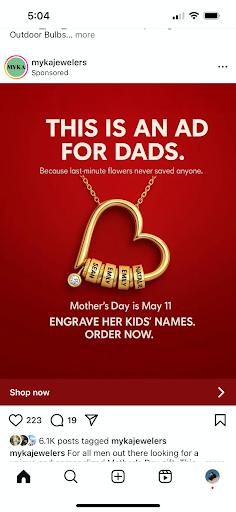
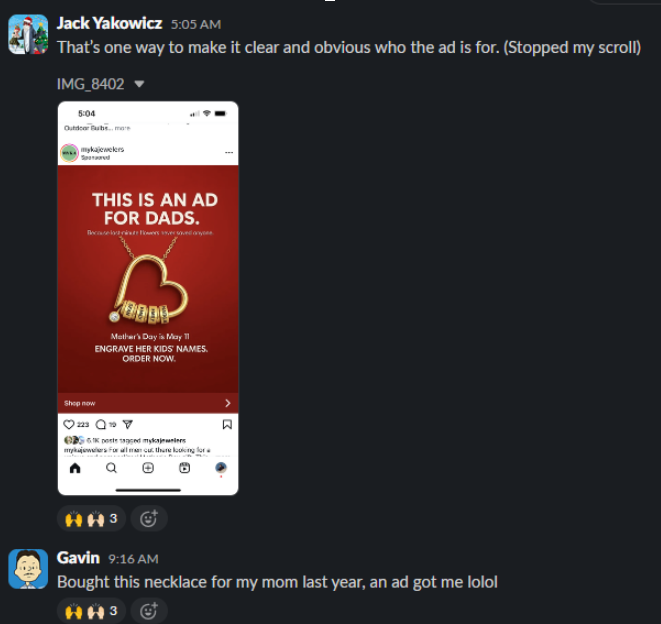
I know what you’re thinking… ads should blend in, they shouldn’t be out of the box or directly call someone out. People HATE ads, let's not make it obvious! And we had that mentality for a while… until we didn’t. Lately, we’ve found that if you skip the fluff and break the fourth wall between you and your audience, the results are impressive.
As a consumer, this style can be annoying if it’s not done correctly. “Here we go… another ad. When does it stop?” But when you’re a consumer and you have an undeniable pain point that’s addressed in one scroll, it makes you stop and think: “Damn. I am a dad who gets my wife flowers for Mother’s Day. Would she like this instead? Maybe I should try something new this year.”
See how easy that was?
Okay… we know it’s not that easy. We know that speaking directly to your audience in an effective way means you need to become your customer and answer their pain point instantly.
The UGC Direction We're Trending Towards
No, we aren’t planning on pausing all UGC ads. We aren’t even planning on telling our creative team to stop making them, but we are starting to shift.
Our new approach is what I like to call “mass amounts of creative output” or what our Director of Marketing would call “creative diversity”. We test multiple different styles, in multiple formats, from multiple creative team members. In the digital marketing world, it’s common to say, “UGC is what’s popular right now. Let’s stick with that.” But what if those tried and true static ads are what your specific target audience wants? What if studio-quality video is needed to introduce your brand? Perhaps a carousel to demonstrate the range of your products. There’s no one-size-fits-all method. That’s why you need to test everything. Right now. All at once.
Here are our recommendations for striking gold fast in the ad world:
1. Test out plenty of different ad styles from the jump.
Don’t go all in on UGC when something else could work better. Start your launch with different types of creative to quickly analyze what works and what doesn’t. This saves you, your client, your client's budget, and your creative team.
2. Don't just learn your target audience, become them.
Even if you are NOT the target audience, learn who they are and what matters to them. Find a pain point so specific that they can’t help but wonder, “How did they know that?”
3. Take a (minor) risk.
If you know your target audience and think “they would hate an ad like this,” you might want to test it anyway (if applicable, of course). It might just resonate in a way you wouldn’t realize.
4. Think outside the box.
Trends come and go, don’t get stuck on the same one and miss out on what could happen if you open up your mind.
How to Make Better User Generated Content
No, UGC is not dead. But bad UGC is. Here are some ways you can avoid the pitfalls of producing bad UGC content:
1. Use authentic video subjects
When directing a new UGC ad, make sure the subject of the video is a good actor. People can see through fakeness online, so you’ll want your actor to be authentic for this one.
2. Don't follow a tight structure
When you watch UGC content online, it all usually starts/looks the same. “POV” or “Okay guys” seem to be overused a lot. Don’t mix in with the UGC crowd, try something new and see if it sticks!
3. Clear messaging
UGC can sometimes be hard to follow. To avoid confusion, use as clear messaging as possible, and be sure to have the product at center stage.
4. Test different hooks
At AdShark, we love to test different hooks to get our link click-through rate as high as possible. It’s one of the fastest, most effective ways to iterate on an ad that’s already running.
5. Short & Sweet
Try to avoid getting on a soap box and make your UGC ad as short and concise as possible! Your audience will thank you.
At AdShark, we’re committed to creating scroll-stopping content - whether it’s UGC, studio polished, or something totally off the wall.
Want help leveling up your ad strategy? Connect with us for a free consultation - we’d love to work with you!