Meta's Andromeda Algorithm & What It Means for Creative Strategy
The algorithm was always using creative as a signal. Now it's doing it at a scale most ad accounts aren't built for.
TL;DR Andromeda reads your creative to find your audience. Diversity is conceptual, not cosmetic. Creative fatigue is about what the system has already clustered and exhausted, not how many ads you're running. High-signal creative beats low-signal creative every time.
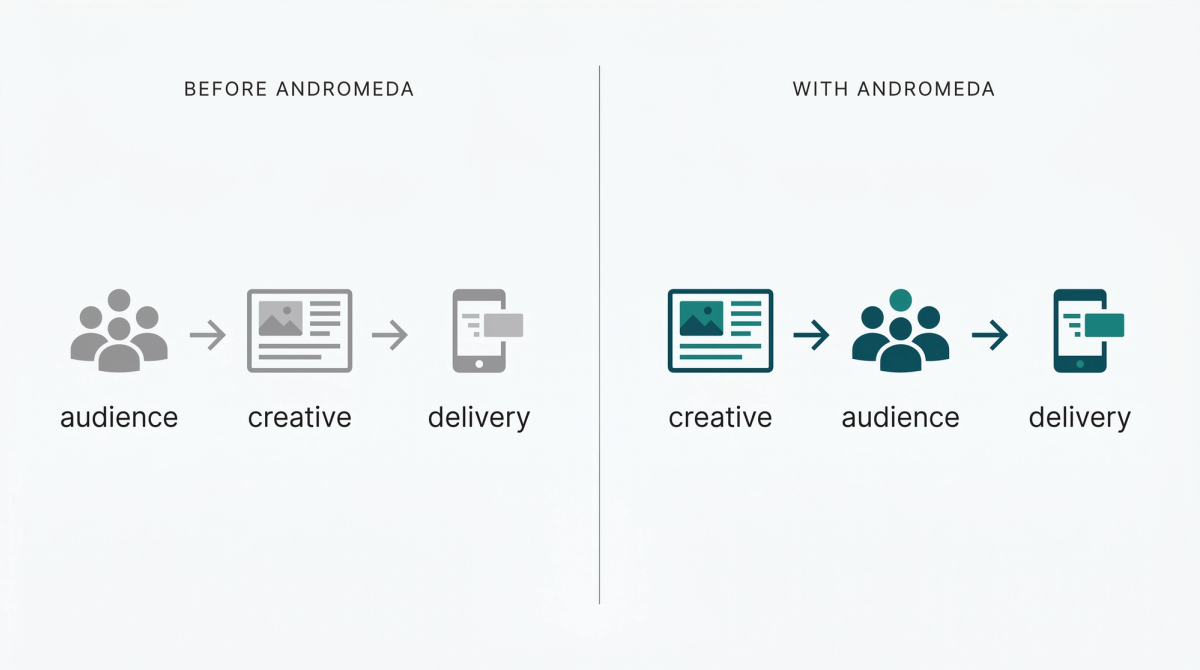
How the role of creative has shifted under Andromeda.
By 2023, most competent Meta advertisers had already landed on some version of the same playbook: broad targeting, creative-led testing, Advantage+ campaigns. The idea that creative could do the targeting work wasn't new. What was missing was a Meta system sophisticated enough to execute that idea at scale.
Andromeda is that system.
Meta's current ad-ranking infrastructure didn't invent creative-as-targeting, but built the machinery that makes it work efficiently. The increase in model complexity to Andromeda—roughly 10,000x—is the key detail here.
The common mental model still goes something like this: build an audience, attach a creative, let targeting do the work. Andromeda doesn't “replace” that sequence—it just supports the very important role of creative within it.
The algorithm now reads the creative itself to help determine who the audience should be. That means an ad isn't just something shown to a pre-selected group of people, it's used by Meta to figure out who to find and show that ad to.
That distinction changes everything about how to think about creative strategy, cadence, and diversity decisions. And the accounts that have figured it out—across e-commerce, lead generation, and B2B—are outperforming the ones that haven't.
What Is Andromeda?
Andromeda is the name of a retrieval and ranking system in Meta. Technically, it refers specifically to the ad retrieval layer—the mechanism that pulls candidate ads from a large pool and ranks them for ad delivery. It is not, in the strictest sense, the full name for Meta's targeting or delivery algorithm. Behaviors like creative informing targeting, broad audiences outperforming narrow ones, the algorithm expanding reach based on what it sees from an ad—are more precisely attributed to Meta's overall delivery algorithm and Advantage+ audience expansion logic, of which Andromeda's retrieval layer is only one part of.
Lattice (another part of that system) handles ranking across objectives and surfaces—determining the final order and frequency of what actually gets served. GEM (yet another) feeds user behavior intelligence into both systems, continuously updating what the algorithm knows about how people engage. You don't need a deep understanding of all three to work effectively in Meta's ecosystem, but knowing the stack exists matters. When your campaign underperforms, the problem could live in any of these layers—and "the algorithm" is not one thing.
Regardless, it's important to know that Meta's system is reading your creative and using it to make targeting decisions, and understanding that is what changes how the work gets done (and how the needle moves).
Before any ad gets auctioned for a placement, Andromeda has already analyzed and sorted which ads are even worth pulling in as candidates. It makes that determination by reading your creative semantically—copy, imagery, overlays, audio, offer language—and matching those signals to users most likely to respond. The creative isn't decoration. It's input data.
How Andromeda Reads Your Creative: High-Signal vs. Low-Signal
Every element in an ad is now a targeting input.
That's not a metaphor—it's how Andromeda's retrieval layer operates. When the system evaluates an ad, it's reading the creative and extracting information about what the ad is offering and who it's likely for, then matching that against user behavior to decide who to retrieve it for.
High-signal creative gives the system something concrete to work with—clear copy, specific offer language, problem/solution framing, captions, product context, text overlays that reinforce what's being said. The algorithm can parse it, categorize it, and find people whose behavior suggests they'd respond to it.
Low-signal creative leaves the system guessing. Abstract visuals, vague copy, aesthetically polished but tonally ambiguous ads—they may look great, but they don't communicate anything specific about the offer or the audience. Andromeda can't match what it can't read.
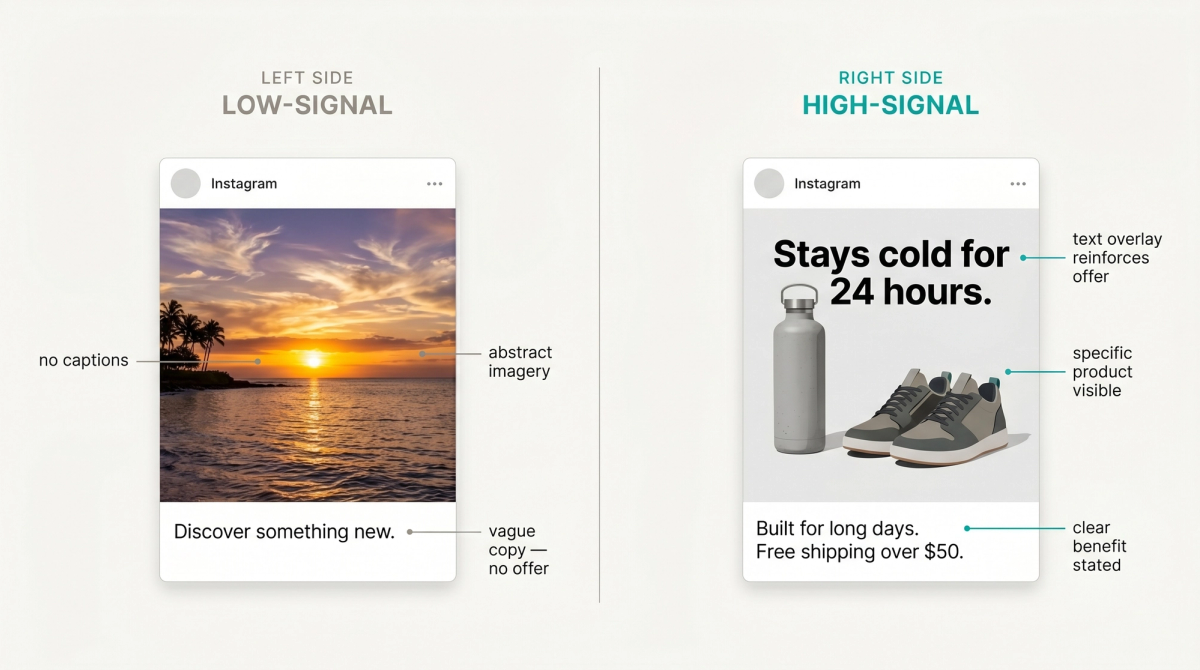
What Andromeda can and can't read in your creative.
Captions are one straightforward example of how this plays out. When the same video runs as two separate ads—one captioned, one not—the captioned version gives the retrieval system text to extract meaning from. The uncaptioned version offers only visual information, which is harder for the system to process. The result tends to be uneven budget allocation: where the captioned version gets spend, the other gets sidelined. What goes into an ad isn't just a creative decision. It's a targeting decision.
How the System Sees Sameness: Creative Clustering & Fatigue
Most discussion of Andromeda focuses on how it reads individual ads. The part that gets missed is what it does with a group of them.
Andromeda uses hierarchical indexing that groups ads by semantic similarity. It evaluates “clusters”—not individual ads in isolation. If an account is running 10 ads that are variations on the same concept, the system doesn't see 10 distinct candidates competing for 10 audience slots. It sees one cluster of similar ads competing for one slot. Two ads with different headlines but identical visuals are, from Andromeda's perspective, the same ad. The diversity doesn't register at the level that matters.
This is what's actually driving faster creative fatigue. If the conceptual diversity in an account is lower than the raw ad count suggests, the system's effective candidate pool is smaller than it appears—and a smaller effective pool means the algorithm exhausts its best matches faster than expected. Replacing a fatiguing ad with a variation of the same concept doesn't introduce a new branch for the system to explore. It just restocks the same shelf.
What actually extends shelf life is maintaining enough genuinely distinct concepts in the active set so the algorithm always has separate clusters to work with—creative strategy. The question worth asking isn't "how often should we refresh?" It's "when we refresh, are we introducing something conceptually new?"
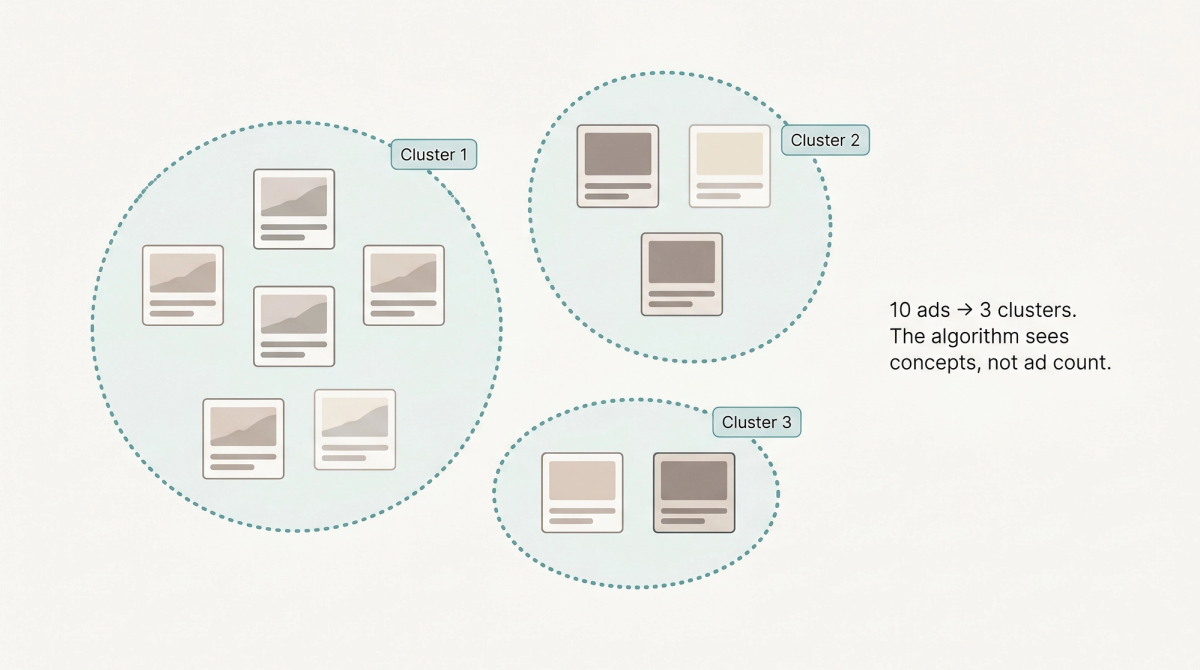
Ten ads, three clusters. The algorithm sees concepts, not volume.
Creative Improvement Cycle
Consistently introducing new creative, reading the data, and knowing when to pivot strategy or scale winners is important. Below is a starting framework that could be applied to any ad account.
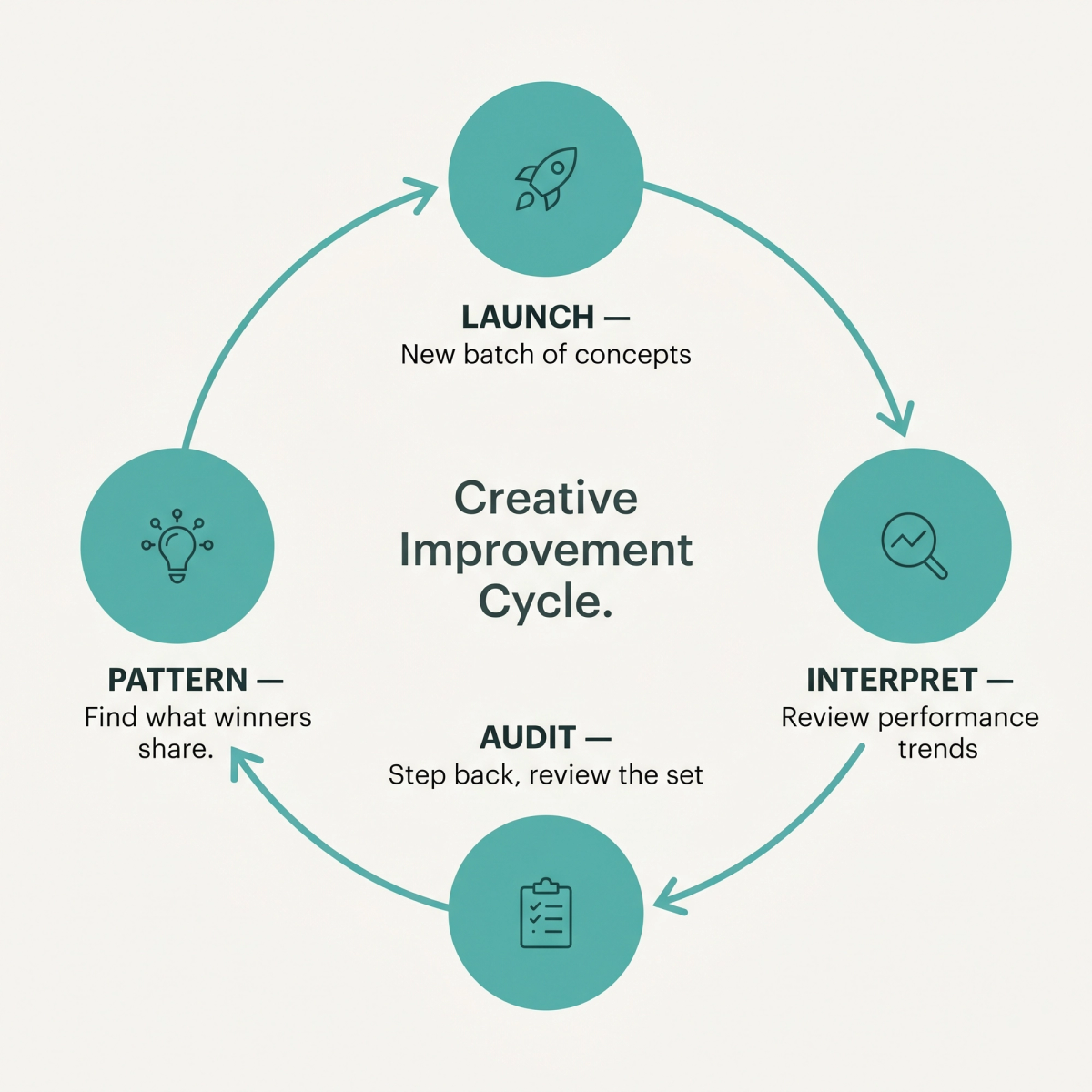
A sustainable rhythm for creative testing under Andromeda.
Launch a new batch of concepts.
Interpret ad performance—review ad-level performance trends and be ready to replace your weakest performing ads. Look for creatives that are losing spend allocation or trending down on consecutive weeks.
Step back and audit your approach—analyzing ad-level performance is helpful when testing different concepts, but don't get lost in the weeds. Take time to step back from individual ad performance and look at the full active creative set. Ask yourself: is there too much of one format—which can lead to fatigue and leaves nothing in reserve.
Find the patterns & record learnings—look back at the top performers. What did they have in common? Use those patterns to inform the next cycle of ad testing. Then resist the urge to just “remake” the ad that worked. The goal is to understand WHY the winning ads worked and build something new from it.
Tying it All Together
The system has gotten better at rewarding the fundamentals of good advertising. That's really what Andromeda changes—not the principles, but the precision with which they get enforced.
A few things worth carrying out of this piece:
- Andromeda reads your creative to find your audience. The copy, imagery, captions, and message in an ad are all signals the algorithm uses to decide who sees it.
- Diversity is conceptual, not cosmetic. Audit your active creative set for semantic distinctness, not ad count. Ten variations of the same concept is one concept. Five genuinely different angles is five.
- Fatigue and diversity. The fix isn't producing faster—it's ensuring that when you refresh, you're introducing something the system hasn't already clustered and exhausted.
- Consider high-signal versus low-signal creative, not format. An ad that clearly communicates what it's offering and who it's for gives the algorithm something to work with.
- Find a testing rhythm that has a sustainable structure. Staggered launches, weekly ROAS monitoring, and genuine creative diversity—not volume—are what keep a portfolio healthy.
Building a strategically diverse creative portfolio isn't a one-time project. It's ongoing work—auditing what's in market, reading what the algorithm is rewarding, retiring concepts that have exhausted their signal, and introducing genuinely new ones on a cadence that keeps the system engaged.
If you want a team that understands how Andromeda evaluates creative and builds accordingly—from the initial brief through to performance analysis—that's the work we do at AdShark.
AdShark is a performance-based digital marketing agency headquartered in Fargo, N.D. Creative performance data referenced in this article reflects activity across client accounts managed by AdShark. The creative-as-targeting framing throughout this post reflects behavior observed in broad audience and Advantage+ set ups, which represent the majority of the accounts referenced. Specific audience inputs continue to work as harder constraints in certain campaign types—particularly lead generation campaigns not using Advantage+ Audience—and strategy should be adjusted accordingly.